Cosmo3DFlow: Wavelet Flow Matching for Spatial-to-Spectral Compression in Reconstructing the Early Universe
Aug 2026· ,,,,
Md Khairul Islam
Zeyu Xia
Ryan Goudjil
Jialu Wang
Arya Farahi
Judy Fox
Abstract
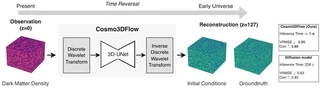
Reconstructing the early universe from the evolved present-day universe is a challenging and computationally demanding problem in modern astrophysics. We devise a novel generative framework, Cosmo3DFlow, designed to address dimensionality and sparsity, the critical bottlenecks inherent in current state-of-the-art methods for cosmological inference. By integrating 3D Discrete Wavelet Transform (DWT) with flow matching, we effectively represent high-dimensional cosmological structures. The Wavelet Transform addresses the “void problem” by translating spatial emptiness into spectral sparsity. It decouples high-frequency details from low-frequency structures, and wavelet-space velocity fields facilitate stable ordinary differential equation (ODE) solvers with large step sizes. Using large-scale cosmological N-body simulations at \(128^3\) resolution, we achieve up to \(46\times\) faster sampling than diffusion models. Our results enable initial conditions to be sampled in seconds, compared to minutes for previous methods.
Type
Publication
Proceedings of the 32nd ACM SIGKDD Conference on Knowledge Discovery and Data Mining V.2 (KDD 2026), 11153-11164. Association for Computing Machinery
Generative AI
Efficient Sampling
Flow Matching
Generative Models
Wavelet Representation
Spatial Sparsity
Spectral Sparsity
Astronomy
Authors
Md Khairul Islam

Authors
Zeyu Xia
(he/him)
Computer Science PhD Student
I am a Computer Science PhD student at the University of Virginia, advised by Prof. Geoffrey C. Fox. My research focuses on generative models and differentiable simulation for science. I build efficient methods for scientific data generation and inverse problems, and evaluate how well models capture physical behavior.
I also contribute to DeepVELA, exploring agentic benchmarks for scientific applications in collaboration with MLCommons.