PyTorchFire: A GPU-accelerated wildfire simulator with Differentiable Cellular Automata

Abstract
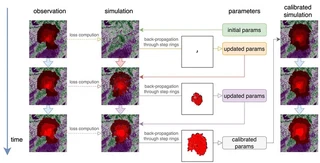
Accurate and rapid prediction of wildfire trends is crucial for effective management and mitigation. However, the stochastic nature of fire propagation poses significant challenges in developing reliable simulators. In this paper, we introduce PyTorchFire, an open-access, PyTorch-based software that leverages GPU acceleration. With our redesigned differentiable wildfire Cellular Automata (CA) model, we achieve millisecond-level computational efficiency, significantly outperforming traditional CPU-based wildfire simulators on real-world-scale fires at high resolution. Real-time parameter calibration is made possible through gradient descent on our model, aligning simulations closely with observed wildfire behavior both temporally and spatially, thereby enhancing the realism of the simulations. Our PyTorchFire simulator, combined with real-world environmental data, demonstrates superior generalizability compared to supervised learning surrogate models. Its ability to predict and calibrate wildfire behavior in real-time ensures accuracy, stability, and efficiency. PyTorchFire has the potential to revolutionize wildfire simulation, serving as a powerful tool for wildfire prediction and management.
Type
Publication
Environmental Modelling & Software, 188, 106401. Elsevier BV
Wildfire Simulation
Differentiable Cellular Automata
PyTorch-Based Software
Parallel Computing Techniques
GPU-Acceleration

Authors
Zeyu Xia
(he/him)
PhD student
Zeyu Xia is pursuing his Ph.D. in Computer Science at the University of Virginia,
fortunately under the expert guidance of the esteemed
Prof. Geoffrey Fox.
His research focuses on AI for science, with a
particular emphasis on generative models, differentiable simulation and
inverse problems. Zeyu is driven by a passion for innovation and a
commitment to making cutting-edge technologies accessible to a broader audience.