Chromium-based BCC-superalloys reinforced by B2-CoAl intermetallic precipitates

Oct 2026·
Xianbing Zhang
,
Thomas Blackburn
,
Cheng Ding
,
Jie Wang
,
Mengmeng Wang
,
Minghao Ma
,
Luobin Yu
,
Shengnan Yang
Zeyu Xia
Zeyu Xia
,
Sibo Cheng
,
Binbin He
,
Alexander J Knowles
,
Kan Ma
Abstract
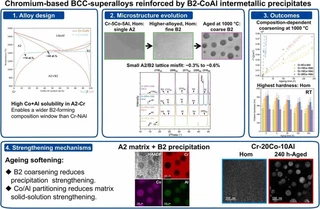
Chromium (Cr)-based body-centred cubic (BCC)-superalloys strengthened by ordered B2 intermetallic precipitates are promising for structural service at 700-1000 °C, where conventional Ni-based superalloys approach their temperature limits. However, their design space is restricted by the low solubility of B2-forming solutes such as Ni + Al in A2-Cr, which limits the attainable B2 fraction and compositional flexibility. Here, CoAl is introduced as an alternative B2 phase, and precipitation, coarsening, and strengthening in Cr-Co-Al alloys are systematically investigated. Vacuum arc-melted alloys were homogenised at 1450 °C, water quenched, and aged at 1000 °C for up to 240 h. Microstructural analysis reveals strong composition dependence of B2 precipitation. After homogenisation, Cr-5Co-5Al and Cr-10Co remain single-phase A2-Cr, whereas higher-alloyed compositions develop A2 + B2 microstructures. B2-CoAl precipitates remain spherical and reach a maximum area fraction of 34% in Cr-15Co-15Al after 240 h. The A2/B2 lattice misfit is small (-0.3% to -0.6%), indicating favourable coherency for high-temperature performance. Cr-10Co-10Al shows a substantially lower B2 coarsening rate than the reported Cr-10Ni-10Al analogue, indicating improved precipitate stability. All ternary alloys show peak hardness in the homogenised condition: Cr-20Co-10Al reaches 842 HV at room temperature and retains 489 HV at 1000 °C, while B2-free Cr-10Co remains ~510 HV because of strong Co solid-solution strengthening. Ageing softening is attributed to the combined effects of B2 coarsening and Co/Al partitioning, which reduce precipitation and matrix solid-solution strengthening, respectively. These results identify B2-CoAl precipitation as a promising strategy for Cr-based BCC-superalloys.
Type
Publication
Journal of Alloys and Compounds, 1082, 191435. Elsevier BV
publications
Zeyu Xia
Authors
Zeyu Xia (he/him)
Computer Science PhD Student

I am a Computer Science PhD student at the University of Virginia, advised by Prof. Geoffrey C. Fox. I develop generative AI (GenAI) and scientific machine learning methods, with a focus on flow matching and GPU-accelerated differentiable simulation. My work connects efficient sampling, benchmark design, and model evaluation with inverse problems in the physical sciences. I contribute to DeepVELA, a Genesis Mission project exploring agentic benchmarks for scientific applications in collaboration with MLCommons. My work spans time, energy, space, cost, and precision evaluation and agent harness design with structured, verifiable outputs. I have also prototyped and trained JEPA world models.

I am seeking 2027 research internships in generative AI and ML systems. Get in touch.